

You can write the most compelling sales page in the world. You can list every feature, every benefit, every proof point. But nothing—nothing—builds trust faster than hearing a real customer say, in their own words, that working with you was worth it.
That’s why testimonial videos are the highest-converting content format in most businesses’ marketing libraries. The data backs it up: 96% of consumers have watched an explainer video to learn about a product or service, and 85% say watching a video convinced them to make a purchase.
But “testimonial video” is a broad category. The format matters. The structure matters. The way you film, edit, and deploy the video makes the difference between a testimonial that sits in a folder and one that actively drives revenue.
This guide breaks down seven testimonial video formats that consistently build trust and convert prospects—with a breakdown of what makes each one effective, where to use it, and when it’s the right choice for your business.
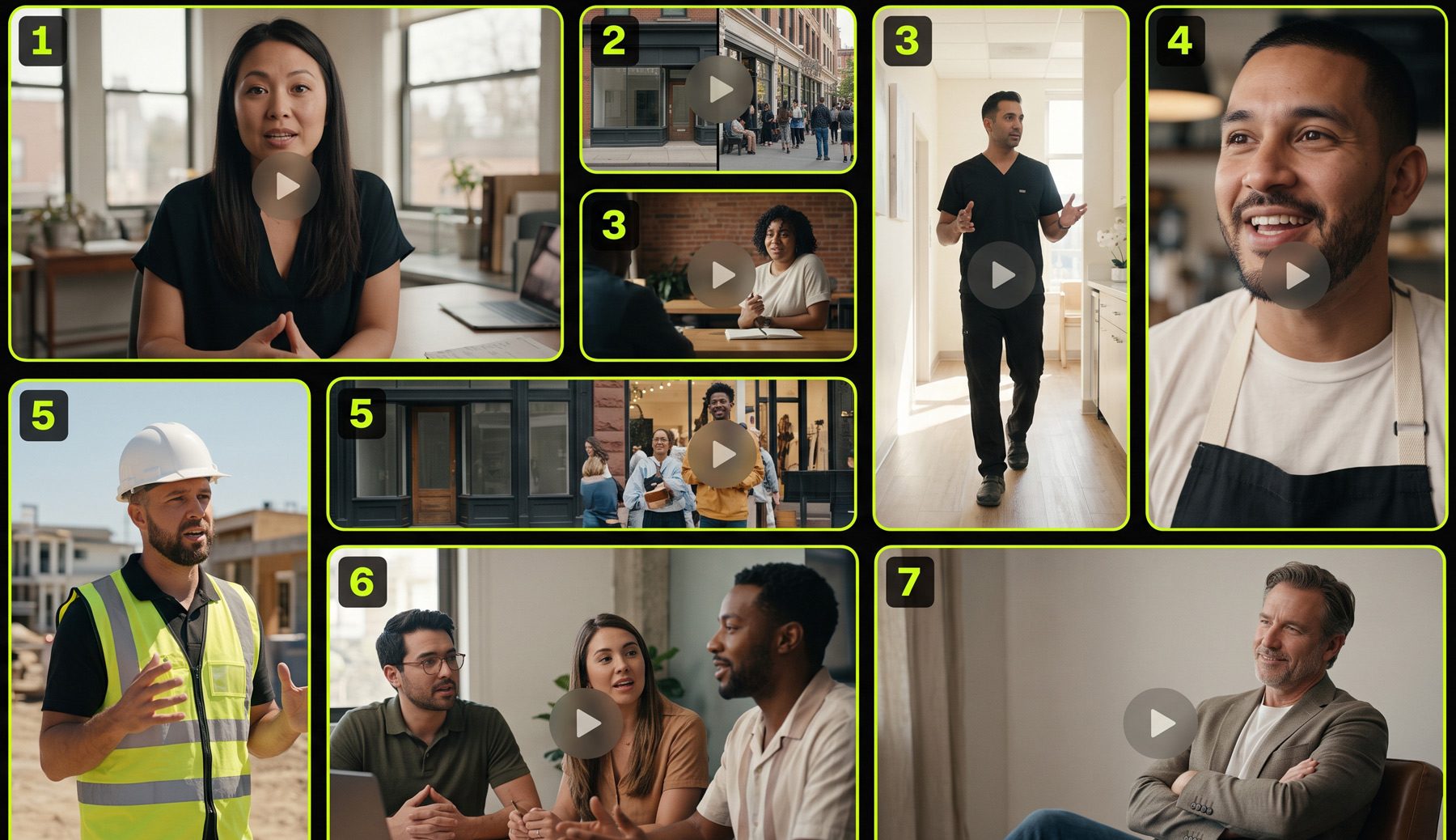
1. The Straight-to-Camera Interview
Format: A customer sits on camera and answers 3–5 guided questions about their experience with your business. Typically 60–90 seconds, shot in their workspace or at your location.
Why it works: This is the gold standard because it’s authentic and personal. A real person, looking at the camera (or just off-camera at an interviewer), speaking in their own voice about a real experience. There’s no script to hide behind, and viewers can read the body language, tone, and emotion. When someone says “I was skeptical, but then…” on camera, that’s more persuasive than any written review.
Best for: Your portfolio page, homepage testimonials section, and sales proposals. This is the workhorse format.
Production tip: The interviewer’s questions matter more than the customer’s prep. Ask about the problem they had before, why they chose you over alternatives, what the experience was like, and what results they’ve seen. The best testimonials follow a natural story arc—not a checklist of features.
2. The Before-and-After Story
Format: The customer describes where their business was before working with you, what the engagement looked like, and where they are now. The structure is explicitly chronological: before, during, after.
Why it works: Transformation stories are the most compelling narrative structure in marketing because they mirror the prospect’s own journey. The viewer sees themselves in the “before” state and can project themselves into the “after.” When a dental practice owner says “Our social media was dead—we hadn’t posted in six months. After the shoot, we had 90 days of content and engagement went up 300%,” that’s a story the next dental practice owner can see themselves living.
Best for: Case study blog posts, LinkedIn thought leadership, sales follow-up emails, and retargeting ads.
Production tip: Include specific numbers whenever possible. “Our engagement increased” is good. “Our engagement increased 340% and we booked 14 new consultations” is unforgettable.
3. The Day-in-the-Life Testimonial
Format: The camera follows the customer in their natural environment—their office, their store, their clinic—while they narrate how your product or service fits into their daily business operations.
Why it works: Context is everything. When prospects see someone in their own industry, in a space that looks like their space, talking about results they want—the mental gap between “that could work for them” and “that could work for me” closes instantly. This format also lets you show your work in use: the overview video playing on the customer’s reception TV, the social clips in their Instagram feed, the testimonial embedded on their website.
Best for: Industry-specific marketing. If you’re targeting dental practices, show a dental practice. If you’re targeting medspas, show a medspa. The specificity is the selling point.
Production tip: Capture plenty of footage of the environment—the space, the team, the customers. This footage doubles as social content and case study imagery.
4. The Results-Only Testimonial
Format: A short, punchy clip (30–45 seconds) where the customer states a specific result—a number, a metric, a before-and-after data point—with minimal storytelling. Think of it as a video pull quote.
Why it works: Attention spans are short. Sometimes you don’t need the full story—you need the punchline. When a business owner says “We booked $45,000 in new business in the first 90 days after the video went live,” that’s a 10-second clip that does more work than a 5-minute brand film.
Best for: Social media clips (especially Instagram Reels and LinkedIn), paid ad creative, website trust bars, and email signature links.
Production tip: These are usually pulled from longer interview footage—not filmed separately. During your full testimonial interview, listen for the quotable moments and flag them for the editor.
5. The Side-by-Side Comparison
Format: A testimonial that explicitly compares your service to what the customer was doing before—whether that’s a previous vendor, DIY efforts, or simply doing nothing. The structure is: “We tried X, then we switched to Y, and here’s what changed.”
Why it works: Most prospects aren’t choosing between you and nothing. They’re choosing between you and another option—a competitor, an in-house attempt, or the status quo. A comparison testimonial addresses that decision directly. When a customer says “We spent $3,000 on a freelancer and got one mediocre video. With Wild Animals, we got seven finished pieces for $4,950 and they actually drive results,” that reframes the entire value conversation.
Best for: Consideration-stage prospects. Use on your packages page, in sales proposals, and in bottom-of-funnel email sequences.
Production tip: Never script the comparison. Let the customer tell their own story. Authentic frustration with a previous experience is far more persuasive than a rehearsed talking point.
6. The Team or Employee Testimonial
Format: Instead of (or in addition to) the business owner, the testimonial features a team member—a marketing manager, an operations lead, or a front-desk employee—talking about how the video content impacted their specific role.
Why it works: Different people in the buying process care about different things. The business owner cares about ROI. The marketing manager cares about content quality and turnaround. The operations person cares about how disruptive the shoot day was. A team testimonial speaks to each of those concerns from a peer’s perspective. It also makes the customer’s company look great—which makes them more likely to agree to be featured.
Best for: LinkedIn content (professional audience expects multi-perspective storytelling), detailed case study pages, and proposals to companies with buying committees.
Production tip: Interview 2–3 people from the same company during the same shoot. Intercut their perspectives in the edit for a richer, more credible narrative.
7. The “Skeptic Converted” Testimonial
Format: A testimonial where the customer openly admits they were hesitant, skeptical, or resistant to video before working with you—and then explains what changed their mind.
Why it works: This is the most powerful testimonial format for a simple reason: your prospect IS the skeptic. When they hear someone who shared their exact doubts—“I thought it was too expensive,” “I didn’t think my business was ‘video-ready,’” “I’d had a bad experience with another company”—and then hear that person describe how those concerns were resolved, the objection collapses. It’s not you overcoming the objection. It’s a peer.
Best for: Bottom-of-funnel content. Use in sales follow-ups, on your FAQ page alongside pricing, in retargeting ads targeting website visitors who didn’t convert, and in Gary’s outbound email sequences.
Production tip: Ask the customer directly: “Were you skeptical before you started? What were your concerns?” Most people are honest about their hesitation, and that honesty is the entire value of the clip.
How to Get Testimonials That Actually Convert
The difference between a mediocre testimonial and a revenue-driving one comes down to preparation—not scripting. Here’s the approach that consistently produces the best results:
- Choose customers who had a specific, describable problem. The more concrete their “before” state, the more compelling the transformation story.
- Ask for permission early and make it easy to say yes. The best time to ask is right after delivery, when the customer is excited about the results. Offer to film at their location so they don’t have to travel.
- Use guided questions, not scripts. Send the customer 4–5 questions in advance so they can think about their answers, but never write their words for them. Authentic stumbles and genuine emotion are more persuasive than polished delivery.
- Keep it short. The finished testimonial should be 60–90 seconds. You can film a 15-minute interview and edit it down to the most compelling moments. Nobody watches a 5-minute testimonial.
- Plan for multiple outputs. One testimonial interview can yield the full 90-second testimonial, a 30-second results-only clip for social, a pull quote for your website, and a screenshot for your sales deck. Maximize every minute of footage.
Where to Deploy Your Testimonial Videos for Maximum Impact
Testimonial videos work everywhere in your marketing—but they perform differently depending on placement. Here’s the deployment map:
Homepage: Place your strongest straight-to-camera testimonial near your pricing or CTA section. The prospect has learned what you do; now they need to hear that it works from someone like them.
Portfolio or case study page: Full before-and-after testimonials paired with the project deliverables. Show the work and the reaction together.
Social media: Results-only clips (30–45 seconds) work best for social. Vertical format, captioned for sound-off viewing, with a clear call-to-action.
Sales proposals: Embed the most relevant testimonial—ideally from a customer in the same industry as the prospect. A medspa testimonial in a medspa proposal. A dental testimonial in a dental proposal.
Email sequences: Use the skeptic-converted format in follow-up emails to prospects who showed interest but didn’t book. Subject line: “I had the same concerns you do.”
Paid advertising: Testimonial video ads consistently outperform brand-forward ads because they lead with social proof rather than self-promotion. Use results-only or skeptic-converted clips for retargeting campaigns.
Your Most Persuasive Content Is Already Walking Around
The most effective marketing asset your business can own isn’t something you write—it’s something your customers say on camera. Testimonial videos take the trust that already exists between you and your best clients and scale it to every prospect who visits your website, scrolls your feed, or opens your proposal.
You don’t need a dozen testimonials to get started. Two or three strong ones—a straight-to-camera interview, a before-and-after story, and a results-only clip—are enough to transform your sales process.
And the best part: testimonials can be captured on the same shoot day as your company overview and social clips. One day, one crew, one investment—and you walk away with the most persuasive content library a small business can have.
Wild Animals’ Stampede package ($6,950) includes a customer testimonial video alongside your company overview, 12 social clips, an extended sales edit, and a 90-day content calendar. One shoot. Three months of content. And the social proof that makes every other piece of marketing work harder.